Showing posts with label EVPs. Show all posts

Thursday, July 11, 2013

Villisca House, and Iowa's other Infamous Haunts


Villisca Murder house
When most people think of Iowa, they think of rolling corn fields and cows eating lazily in the cornfields. There is another side to Iowa, a darker, sinister side.Iowa isn't the first place that I'd think of, when I think of the top most haunted place in the United States of America. Really? Iowa? Well, There is the Villisca Murder House, (sometimes called Vallisca, you say tah-mah-ta I say toe-mate-oh. But I'm right. lol.  ) in Iowa that some have heard of, and the television show, one of my favorites (Ghost Adventures) has visited. It is supposed to be a  super creepy, and spooky place, with a surprisingly dark and murderous past.  It turns out that isn't the only haunted place in Iowa. So lets visit a few of them today!


On June 10, 1912, there were 8 murders in the Villisca "soon to be" murder house.  Josiah Moore's family, and two friends' children. There were 2 parents, their 4 children, and their friends' 2 children who were spending the night. Can you imagine the depravity of such a killer? They say a stranger hefting an ax lifted, the latch on the back door of the two-story timber house, easily since it was not locked, crime was something that you worried about in the Villisca settlement of no more than 2,000 people, all of which knew one another. Some say he hid in the attic. Either way, he was somehow able to slip inside the house, silently. Then, according to a reconstruction attempted by the town coroner next day, he took an oil lamp from a dresser, removed the chimney and placed it out of the way under a chair, bent the wick in two to minimize the flame, lit the lamp, and turned it down so low it cast only the faintest glimmer in the sleeping house.


 Still carrying the ax, the stranger walked past one room in which two girls, ages 12 and 9, lay sleeping, and slipped up the narrow wooden stairway leading to the other bedrooms. He ignored one, in which four more young children were sleeping, and crept into the room in which 43-year-old Joe Moore lay next to his wife, Sarah. Raising the ax high above his head—so high it left ax marks in the ceiling, the man brought the flat of the blade down on the back of Joe Moore’s head, crushing his skull and probably killing him instantly. Then he struck Sarah a blow before she had time to wake or register his presence.


     Leaving the couple dead or dying, the killer went next door and used the ax, Joe’s own, probably taken from where it had been left in the coal shed; to kill the four Moore children as they slept. Once again, there is no evidence that Herman, 11; Katherine, 10; Boyd, 7; or Paul, 5, woke before they died. Nor did the assailant or any of the four children make sufficient noise to disturb Katherine’s two friends, Lena and Ina Stillinger, as they slept downstairs. The killer then descended the stairs and took his ax to the Stillinger girls, the elder of whom may finally have awakened an instant before she, too, was murdered. How terrifying for her.


     What happened next marked the Villisca killings as truly peculiar and still sends shivers down the spine a century after the fact. The ax man went back upstairs and systematically reduced the heads of all six Moores to bloody pulp, striking Joe alone an estimated 30 times and leaving the faces of all six members of the family  unrecognizable. He then drew up the bedclothes to cover Joe and Sarah’s shattered heads, placed a gauze undershirt over Herman’s face and a dress over Katherine’s, covered Boyd and Paul as well, and finally administered the same terrible postmortem punishment to the girls downstairs before touring the house and ritually hanging cloths over every mirror and piece of glass in it. At some point the killer also took a two-pound slab of uncooked bacon from the icebox, wrapped it in a towel, and left it on the floor of the downstairs bedroom close to a short piece of key chain that did not, apparently, belong to the Moores. He seems to have stayed inside the house for quite some time, hanging out, A true sociopath, he then, filled bowl with water and, washed his bloody hands in it. Some time before 5 a.m., he abandoned the lamp at the top of the stairs and left as silently as he had come, locking the doors behind him. Taking the house keys, the murderer vanished as the Sunday sun rose red in the sky.


     The Moores were not discovered until several hours later, when a neighbor, worried by the absence of any sign of life in the normally clamorous household, telephoned Joe’s brother, Ross, and asked him to investigate. Ross barely entered the house before he came rushing out again, calling for Villisca’s marshal, Hank Horton. That set in motion a sequence of events that destroyed what little hope there may have been of gathering useful evidence from the crime scene. Horton brought along Dr's. J. Clark Cooper and Edgar Hough and Wesley Ewing, the minister of the Moore’s Presbyterian congregation. They were followed by the county coroner, L.A. Linguist, and a third doctor, F.S. Williams (who became the first to examine the bodies and estimate a time of death). When a shaken Dr Williams emerged, he cautioned members of the growing crowd outside: “Don’t go in there, boys; you’ll regret it until the last day of your life.” Many ignored the advice; as many as 100 curious neighbors and townspeople tramped as they pleased through the house, scattering fingerprints, and in one case even removing fragments of Joe Moore’s skull as a macabre keepsake. Gross. So much for evidence.


     The murders convulsed Villisca, particularly after a few clumsy and futile attempts to search the surrounding countryside for a transient killer failed to unearth a likely suspect. The simple truth was that there was no sign of the murderer’s whereabouts. He had vanished, and was given a head start of up to five hours in a town at which nearly 30 trains called every day, he might easily have made good his escape. Bloodhounds were tried without success; after that there was little for the townspeople to do but gossip, swap theories–and strengthen their locks. By sundown there was not a dog to be bought in Villisca at any price.


Funeral procession for the victims in Villisca house


Moore Family grave sites

The Moores were not discovered until several hours later, when a neighbor, worried by the absence of any sign of life in the normally clamorous household, telephoned Joe’s brother, Ross, and asked him to investigate. Ross barely entered the house before he came rushing out again, calling for Villisca’s marshal, Hank Horton. That set in motion a sequence of events that destroyed what little hope there may have been of gathering useful evidence from the crime scene. Horton brought along Dr's. J. Clark Cooper and Edgar Hough and Wesley Ewing, the minister of the Moore’s Presbyterian congregation. They were followed by the county coroner, L.A. Linguist, and a third doctor, F.S. Williams (who became the first to examine the bodies and estimate a time of death). When a shaken Dr Williams emerged, he cautioned members of the growing crowd outside: “Don’t go in there, boys; you’ll regret it until the last day of your life.” Many ignored the advice; as many as 100 curious neighbors and townspeople tramped as they pleased through the house, scattering fingerprints, and in one case even removing fragments of Joe Moore’s skull as a macabre keepsake. Gross. So much for evidence.


 The murders convulsed Villisca, particularly after a few clumsy and futile attempts to search the surrounding countryside for a transient killer failed to unearth a likely suspect. The simple truth was that there was no sign of the murderer’s whereabouts. He had vanished, and was given a head start of up to five hours in a town at which nearly 30 trains called every day, he might easily have made good his escape. Bloodhounds were tried without success; after that there was little for the townspeople to do but gossip, swap theories–and strengthen their locks. By sundown there was not a dog to be bought in Villisca at any price.

The most obvious suspect may have been Frank Jones, a tough local businessman and state senator who was also a prominent member of Villisca’s Methodist church. Edgar Epperly, the leading authority on the murders, reports that the town quickly split along religious lines, the Methodists insisting on Jones’s innocence and the Moores’ Presbyterian congregation convinced of his guilt. Though never formally charged with any involvement in the murders, Jones became the subject of a grand jury investigation and a prolonged campaign to prove his guilt which destroyed his political career. Many townspeople were certain he used his considerable influence to have the case against him extinguished, crushed. Unfortunately, government corruption still happens. 


     There were at least two compelling reasons to believe that Jones had nursed a hatred of Joe Moore. First, the dead man had worked for him for seven years, becoming the top salesman of Jones’s farm equipment business. But Moore had left in 1907, dismayed, perhaps, by his boss’s insistence on hours of 7 a.m. to 11 p.m., six days a week. Then he set himself up as a head-to-head rival, taking the valuable John Deere account with him. Worse, he was also believed to have slept with Jones’s vivacious daughter-in-law, a local beauty whose numerous affairs were well known in town thanks to her astonishingly indiscreet habit of arranging trysts over the telephone at a time when all calls in Villisca had to be placed through an operator. By 1912 relations between Jones and Moore had grown so cold that the they began to cross the street to avoid each other, an ostentatious sign of hatred in such a minuscule community.

  Few people in Villisca believed that a man of Jones’s age and eminence would have swung the ax himself, but in some minds he was certainly capable of paying someone else to wipe out Moore and his family. That was the theory of James Wilkerson, an agent of the Burns Detective Agency, that announced in 1916 that Jones had hired a killer by the name of William Mansfield to murder the man who had humiliated him. Wilkerson, who made enough of a pest of himself to derail Jones’s attempts to secure re-election to the state senate, and who eventually succeeded in having a grand jury convened to consider the evidence he had gathered–was able to show that Mansfield had the right sort of background for the job: In 1914 he was the chief suspect in the ax murders of his wife, her parents and his own child in Blue Island, Illinois.


     Unfortunately for Wilkerson, Mansfield turned out to have a tightly knit alibi for the Villisca killings. Payroll records showed that had been working several hundred miles away in Illinois at the time of the murders, and he was released for lack of evidence. Paper and words can be manipulated or changed easy enough. So that did not stop many locals, including Ross Moore and Joe Stillinger, father of the two Stillinger girls, from believing in Jones’s guilt. The rancor resentment and bitterness, caused by Wilkerson lingered on in the town for years.

      For others, though, there was a far stronger, and stranger suspect for the ax man. His name was Lyn George Jacklin Kelly, and he was an English immigrant, a preacher and a known perverted deviant with many recorded mental problems. He had been in the town on the night of the murders and freely admitted that he had left on a dawn train just before the bodies were discovered. There were things about Kelly that made him seem an improbable suspect. He stood only 5-foot-2 and weighed 119 pounds, but in other ways he fit the bill. He was left-handed, and Coroner Linquist had determined from an examination of blood spatters in the murder house that the killer probably swung his ax that way. Kelly was obsessed with the at the Villisca house apparently, and had been caught peering into windows in Villisca two days before the murders. 

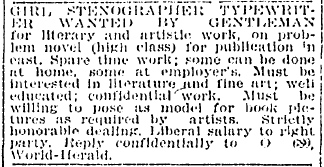
In 1914, living in Winner, South Dakota, he would advertise for a “girl stenographer” to do “confidential work,” and that ad, placed in the Omaha World-Herald, would also specify that the successful candidate “must be willing to pose as model.” When a young woman named Jessamine Hodgson responded,  she received in return a letter, described by a judge as “so obscene, lewd, lascivious and filthy as to be offensive to this honorable court and improper to be spread upon the record thereof.” Amongst his milder instructions, Kelly told Hodgson that she would be required to type in the nude.


Ad Rev. Kelly placed in the Omaha World-Herald. 


     Investigation soon made plain that there were links between Lyn Kelly and the Moore family. Most sinister, for those who believed in the little preacher’s guilt, was the fact that Kelly had attended the Children’s Day service held at Villisca’s Presbyterian church on the evening of the murders. The service had been organized by Sarah Moore, and her children, together with Lena and Ina Stillinger, had played prominent parts, dressed up in their Sunday best. Many in Villisca were willing to believe that Kelly had spotted the family in the church and become obsessed with them, and that he had spied on the Moore household as it went to bed that evening. The idea that the killer had lain in wait for the Moores to go to sleep was supported by some evidence; Linquist’s investigation had revealed a depression in some bales of hay stored in the family barn, and a knot hole through which the murderer could have watched the house while reclining in comfort.             

The Reverend Lyn Kelly

    The preacher had left Villisca three hours before the killings were discovered. It also emerged that Kelly had returned to Villisca a week later and shown great interest in the murders, even posing as a Scotland Yard detective to obtain a tour of the Moore house. Creepy much? Arrested in 1917, the Englishman was repeatedly interrogated and eventually signed a confession to the murder in which he stated: “I killed the children upstairs first and the children downstairs last. I knew God wanted me to do it this way. `Slay utterly’ came to my mind, and I picked up the axe, went into the house and killed them.” This he later recanted, and the couple who claimed to have spoken to him on the morning after murders changed their story. With little left to tie him firmly to the killings, the first grand jury to hear Kelly’s case hung 11-1 in favor of refusing to indict him, and a second panel freed him. Of course.

 Perhaps the strongest evidence that both Jones and Kelly were most likely innocent came not from Villisca itself but from other communities in the Midwest, where, in 1911 and 1912, a bizarre chain of ax murders seemed to suggest that a transient serial killer was at work. The researcher Beth Klingensmith has suggested that as many as 10 incidents that occurred close to railway tracks but in locations as far apart as Rainier, Washington, and Monmouth, Illinois, might form part of this chain, and in several cases there are striking similarities to the Villisca crime. The pattern, first pointed out in 1913 by Special Agent Matthew McClaughry of the Justice Department’s Bureau of Investigation (forerunner of the FBI), began with the murder of a family of six in Colorado Springs in September 1911 and continued with two further incidents in Monmouth (where the murder weapon was actually a pipe) and in Ellsworth, Kansas. Three and five people died in those attacks, and two more in Paola, Kansas, where someone murdered Rollin Hudson and his unfaithful wife just four days before the killings in Villisca. As far as McClaughry was concerned, the slaughter culminated in December 1912 with the brutal murders of Mary Wilson and her daughter Georgia Moore in Columbia, Missouri. His theory was that Henry Lee Moore, Georgia’s son and a convict with a  history of violence, was responsible for the whole series.
Convicted ax murderer Henry Lee Moore was 
the suspect favored by Department of Justice

Blanche Wayne, of Colorado Springs, may have been the first victim 
of a Midwest serial murderer in 1911. 


      It is not necessary to believe that Henry Lee Moore was a serial killer to consider that the string of Midwest ax murders have intriguing similarities that may tie the Villisca massacre to other crimes. Moore is now rarely considered a good suspect; he was certainly an unsavory character—released from a reformatory in Kansas shortly before the ax murders began, arrested in Jefferson City, Missouri, shortly after they ended, and eventually convicted of the Columbia murders. But his motive in that case was greed–he planned to obtain the deeds to his family house–and it is rare for a wandering serial killer to return home and kill his own family. Nonetheless, analysis of the sequence of murders—and several others that McClaughry did not consider—yields some striking comparisons.


The use of an ax in almost every case was perhaps not so remarkable in itself; while there certainly was an unusual concentration of ax killings in the Midwest at this time, almost every family in rural districts owned such an implement, and often left it lying in their yard; as such, it might be considered a weapon of convenience. Similarly, the fact that the victims died asleep in their beds was likely a consequence of the choice of weapon; an ax is nearly useless against a mobile target. Yet other similarities among the crimes are much harder to explain away. In eight of the 10 cases, the murder weapon was found abandoned at the scene of the crime; in as many as seven, there was a railway line nearby; in three, including Villisca, the murders took place on a Sunday night. Just as significant, perhaps, four of the cases—Paolo, Villisca, Rainier and a solitary murder that took place in Mount Pleasant, Iowa—featured killers, or maybe just one lone Ax Murderer,  who covered the victims’ faces, three murderers had washed at the scene, and at least five of the killers had lingered in the murder house. Perhaps most striking of all, two other homes (those of the victims of the Ellsworth and Paola murders) had been lit by lamps in which the chimney had been laid aside and the wick bent down, just as it had been at Villisca. 

There have been a number of documentaries, it was featured on Ghost Adventures, there are a ton of websites, facebook accounts and research dedicated to the Villisca Murder House. Villisca's "fame" is mostly attributed to the popularity of paranormal shows (including Ghost Adventures), that have featured the house where the murders occurred  Sadly, the Villisca murder scene would be seen again and again .On June 10, 2012, a number of newspapers covered the 100 year anniversary of Iowa's most highly profiled crime. There was a new documentary on June 10, 2013, to coincide with the 101st anniversary of the murders. There is a film due to be released in 2014, a modern crime thriller called, "Slay Utterly.  It is inspired by the cases connected with the Ax Man Enigma. I doubt he's still alive if he was already murdering people in 1912. But the press and media will keep him alive. He would love it. And due to my lack of subtlety, I'll be blunt, be smart. Also, in today's crazy world, survival of the fittest. I hate to say it, nor should I have to, but people tend to have the belief it will never be them. They get comfortable in the routine of their day to day lives and get too comfortable.


       The faceless serial killer known as "The Ax Man Enigma," leaving certain crime scene signatures behind. The newspaper did an article on him on Monday June 10, 1912 about the murders at Villisca house.  I'm sure he loved that, especially since he was like a ghost in the wind, he was an unknown. But he was infamous. Every article probably inflated his ego. He was said to probably be responsible for at least two dozen murders. The "Ax Man Enigma" was never brought to justice officially. There were suspects and trials, but the case wasn't solved.


A door in one of the children's bedrooms 
in Villisca house that opens and closes itself          


     So, that's crazy, and there are a lot of random non scary tourist sites in Iowa, for the weak of heart.  They are potentially interesting, and a bit corny. Worth a look for sure.They have crazy sights to see, like "The World's Biggest Strawberry","Snake Alley", the world's crookedest street, Riverside,Iowa, future birthplace of James T. Kirk, the original star ship captain in "Star Trek", and they even have a "Road Cheese Hyper tour" that lasts 7 days and is $100. I hope you eat food besides just cheese for 7 days! Haha. So check out those attractions while in the area. Now we will visit the other most haunted places in Iowa, roadside attractions and strawberries aside. Then there are several haunted places to visit white you are in Iowa. Continue with me on our haunted journey.


Snake Alley


Abraham Lincoln High School


     The Abraham Lincoln High School, in Des Moines, Iowa, is the largest high school in the state.This  expansive two story auditorium is known for it's mural of "The Gettysburg Address" on it's wall, but to it's students and alumni it is more well known for the paranormal experiences that go on there. Often people report seeing lights, orbs and  and shadows in the balcony, only to be told or shown that nobody is up there. Some have reported seeing the seats fold down on their own, or walking through cold spots. The Drama and Choir departments hold the most stories of this place, however. The wings are a place where costumes move, and where the curtains and ropes seem to swing by themselves, and some even claimed to have felt fingers running up their back. This is a place to go if you want to see a production that seems to continue for some, after death.


The Lincoln High School Auditorium

Mason House


The Mason House in that is located in Bentonsport, Iowa is supposedly very haunted.The Mason House Inn is a 164 year old bed and breakfast situated on the banks of the Des Moines River. There have been several reported ghostly encounters in this inn reported by both staff and guests. It has become a very popular place for paranormal investigators to visit.  The Mason House Inn has a long history and has served as more than an inn in it's 164 years of existence. The Mason House (Originally called Ashland House) was built in 1846 by Mormon craftsman who stayed in Bentonsport for several years on their way to Utah from Nauvoo, Illinois. The house was built for William Robinson who used it as a hotel for steamboat travelers on journeys down the Des Moines River Lewis and Nancy Mason purchased the house in 1857 and renamed it as the Phoenix Hotel, however, everyone soon took to calling it the Mason House and it has stayed that ever since. The Mason house served as an army hospital during the civil war. It was also a station on the Underground Railroad.The hotel was in the Mason family for 99 years and many members of the family died there and are still there, so go check it out and see if you have any paranormal visitors!
Mason house back then


Reported hauntings in the house include hearing footsteps in empty rooms, hearing voices and strange noises, and even seeing apparitions! One guest reported seeing the bed in her room partially lift into the air. There have also been reports of lights flashing on and off and alarms going off without being set.


     The "Buddy Holly Crash Site," in Clear Lake Cornfield, Iowa is said to be haunted by rock icons that died tragically. A lot of people, fans especially, remember this tragic event and loss of talent. In the middle of a cornfield there is a memorial to the three famous musicians, rock n' roll stars Buddy Holly, Richie Valens, and the Big Bopper. They had just performed Feb 2, 1959, at Surf Ballroom in Clear Lake, Iowa. Shortly after midnight, (the 3rd officially) the three rock stars took off in a charted plane that promptly crashed on take off, killing the pilot and the three rock stars. 


Crash Site


      Buddy and Ritchie were in their early twenty's and they were rising stars. In 1971, Don Mclean wrote his famous song, the "American Pie", in it he referred February 3, 1959 as the "day the music died". Don must not like the rock stars after that, because he believed the rock music die that day. Those who venture here at night hear voices and see orbs and other lights dart in and around the cornfields that surround the memorial. Many believe that it is the spirits of the musicians, looking for a venue to play their music in. Since then, Lewis said, “mysterious figures have been spotted along the secluded road” and “some people say they hear music in the distance.”
 

Buddy Holly Memorial

Another crash site memorial


Mathias Ham


      The Mathias Ham House in Dubuque, Iowa has had more than it's share of paranormal activity.  It was built in 1837 by Mathias Ham. The home started out with two-stories and five rooms that overlooked the lazy Mississippi river. This, significantly smaller home, provided the shelter that Mathias needed for his wife and children. As the years passed, witnesses say that after the death of Mathias's wife, he added an additional three-stories were to the house; giving the family a total of twenty-three rooms! Mathias made his fortune in the mining, lumber, agriculture and shipping vessels that floated down the Mississippi. Mathias spent quite a bit of time in the very top room of the house where he could see the river and he could keep an eye on his ships. Pirates were also a problem. One day, Mathias spotted pirates on the river and alerted the authorities.


Mathias house tower
     By the end of the eighteen-hundreds, the only living family member left was Sarah Ham, one of Mr. Ham's daughters. Sarah lived in this enormous home by herself. One night while Sarah was in bed reading, she heard someone moving around on the floor below her. She crept quietly down to investigate but the intruder had already vacated. The next day, Sarah alerted her neighbors to the previous nights activities and told them if it happened again, she would place a light in the window to call on them for help.That night she heard the intruder again. This time she called out to ask who was there. No answer came and she went back into her room and locked the door. Sarah then placed the lantern in the window and readied her shotgun to defend herself. Heavy footsteps made their way up the steps and stopped right outside her bedroom door. Sarah fired off two shots. They were decent shots, because when the neighbors arrived, they followed a bloody trail down to the river and found the pirate captain who had threatened Mathias, dead along the river bank.  So, she inadvertently avenged her father in a way. She was gutsy. Today, the mansion is a museum and is said to be haunted by several restless apparitions. Unexplainable lights have been seen, floating down the dark corridors and stairways throughout the mansion.


The Mathias House


     Many have reported hearing strange and unidentifiable noises coming from the top room of the house. It is believed that Mathias himself haunts this room; still watching the river for his ships. At least one of the spirit occupants is said to make visitors feel uneasy. Many have reported bodily chills or feeling as if someone were watching them. Others have reported eerie, cold spots or gusts of icy cold air that seems to come from nowhere. This may be the pirate that lost his life so unexpectedly here. One of the employees here reported hearing the old pump organ play after the lights were turned out. When she turned the lights on, no one was there. The organ was not supposed to be in working order at that time and it was closed up! The sounds of voices have been heard inside and outside of the museum, as well as, disembodied footsteps. Many employees have claimed to hear odd noises in the basement, close to where an old tunnel used to be located but, the tunnel caved in years ago.


Mathias house hallway


     It seems to me that this old home has its share of paranormal activity. The villa is open for tours, and those who go on them, tend to get more than they bargained for. It's twenty-three rooms are filled with authentic furnishings which in turn, make some of it's passed residents forgetful of their deaths. Visitors often report walking through cold spots, hearing voices call down the echoing halls, and lights flicker when no one is near the switch. Even the employees of the museum report voices and even more disturbing, objects moving on their own. If you take this tour, you may just meet a resident from long ago. Bring your cameras! And your bravery- because you may meet a ghost or 2, more if you are lucky:)


Independence State Mental Hospital


     The Independence State Mental Hospital in Iowa has a bit of a twisted history, also, I find the name rather ironic.  Independence Mental Hospital? The patients probably didn't feel too "independent" there. The original plan for patients was to relieve crowding from the hospital at Mount Pleasant and to hold alcoholics, geriatrics, drug addicts, mentally ill, and the criminally insane. The hospital's many names include: The Independence Lunatic Asylum, The Independence State Asylum, The Independence Asylum for the Insane, The Iowa State Hospital for the Insane, and The Independence Mental Health Institute. There is also a labyrinth of underground tunnels which connect every building. Like most asylums of its time, it has had a gruesome and dark history. Remnants of this are the graveyard, hydrotherapy tubs, and lobotomy equipment.


     A still functioning mental hospital, Independence State Mental Hospital, is a major flocking spot to those who want to experience the paranormal. While the majority of the building is still in use, there is the older part that is closed and usually only opened for school tours. It was in this part of the building that lobotomies and electric shock therapy used to be performed on patients. Those who have toured the building in the day recall cold drafts, whispers, and the feeling of being watched. Those who work there often avoid the area if possible, seeing shadows and hearing screams. It is still the home of the patients who lost their minds so long ago.


Iowa State Penn

      The State Penitentiary in Fort. Madison, Iowa was built in the 1800's. It housed early Iowa's more hardened criminals. Those who are interned there today often report of cold spots in certain cells, have heard chains and clanking in the halls, and some have even claimed to have been attacked viciously. Guards often refuse to go the end of the solitary confinement area at night citing dark feelings, and the feeling of being watched intently. While most of the prisoners get to leave after their sentences, the activity here tends to suggest that some have never left.


Iowa State Penitentiary


     If you get a chance, go visit Iowa, and it's haunted sites.  Or you can visit the big strawberry, or both! Whatever floats your boat. I've definitely added it to my list of haunted places to visit! I'll leave you with some random ghost pictures from Iowa. Enjoy!


<a href="http://www.listia.com/?r=836162"><img alt="Auctions for free stuff at Listia.com" src="http://www.listia.com/assets/banners/468x60c1-838a1d3e338431b7528e3aebe8276e2b.gif" /></a>

Tuesday, October 2, 2012

Walk in the Footsteps of Gettysburg's Haunted History

  
      My fascination with the paranormal has led me to add Gettysburg, Pennsylvania to my list of "The Most Haunted Places in the United States that I'd Love to Visit."  I also was born in Hershey Pennsylvania.  That's why I'm so sweet. Haha, just kidding. Anyway, Gettysburg has been named by many as the most haunted place in America.  The town is home to a surprising number of phantom forms, showing up in photos. The ghost of what appears to be Confederate General Robert E. Lee, has shown up in several pictures. All cultures throughout time have been fascinated by the dead, apparitions, ghosts, strange occurrences and unexplained phenomena. Television shows and "Ghost hunters" have an overwhelming interest in the "Haunted History" of Gettysburg.  Both the Sci-Fi and Travel Channel have featured Gettysburg in shows. "Ghost Adventures" had some interesting experiences there in fact.  They acquired evidence of hauntings in Gettysburg and recorded some  EVPs (electronic voice phenomena).

Here is the link to the YouTube video where the "Ghost Adventures" recorded some EVP's.
  http://www.travelchannel.com/video/eerie-evidence-at-gettysburg-12203


    The story of Gettysburg is larger and rooted deeper than just the 3 bloody days during the Civil Wary in July of 1863.  Gettysburg has several haunted sites we are visiting today in my blog. The most haunted area, is the Gettysburg Battlefield, of course. The Battle of Gettysburg, Pennsylvania (July 1–July 3, 1863), was the largest battle of the American Civil War as well as the largest battle ever fought in North America, involving around 85,000 men in the Union’s Army of the Potomac under Major General George Gordon Meade and approximately 75,000 in the Confederacy’s Army of Northern Virginia, commanded by General Robert Edward Lee. It was a crucial meeting between the North and South.  This bloodbath would change American history, forever.


     When the cannon smoke cleared,  there was blood everywhere; permanently marking the battlefield. An estimated 569 tons of ammunition was fired during the three days of fighting. Casualties at Gettysburg totaled 23,049 for the Union (3,155 dead, 14,529 wounded, 5,365 missing). Confederate casualties were 28,063 (3,903 dead, 18,735 injured, and 5,425 missing), more than a third of Lee’s army. The Confederate Army had suffered largely irreplaceable losses.  This was a turning point in the war.  After the battle, bodies lay scattered throughout Gettysburg’s farmlands. Burial work commenced quickly as fears of epidemic rose.  The dead were hastily buried in shallow graves on the battlefield, crudely identified by pencil writing on wooden boards. Rain and wind began eroding the impromptu graves, and Gettysburg’s citizens called for the creation of a soldiers’ cemetery for the proper burial of the Union dead. With the support of the Pennsylvania Governor, a committee formed to select a site for the cemetery and oversee the proper burial of Union remains.  The state purchased the property, and the reburial process began. The site chosen encompassed the hill from which the Union center repulsed Pickett’s Charge. Known as Gettysburg National Cemetery, it is the final resting place for more than 3,500 Union soldiers killed in the Battle of Gettysburg. Abraham Lincoln’s Gettysburg Address was delivered November 19, 1863, at the dedication of the “Soldiers National Cemetery” at Gettysburg. The speech was extremely short by the standards of the day and received scant notice at the time, but its concise, powerful wording has made it one of the best-known public addresses in all of history.


     After losing the battle at Gettysburg, and ultimately the war, many of the confederate soldiers who gave their lives for their country, never received a proper burial. This isn't surprising since The Union won, why bother with your dead enemies?  Even in the most primitive of cultures they bury the dead.  They didn't want the hassle and didn't bother with the courtesy of a proper burial, or sending the bodies home to their families.  So, as the Union tended to their own dead and wounded soldiers, Confederate soldiers rotted in mass graves. The stench was unbearable. Efforts in the 1870s by Southern veterans' societies eventually relocated 3,200 Confederate remains to cemeteries in Virginia, Georgia, and the Carolinas.


     Next year, in 2013 Gettysburg is having their 150th anniversary, a tribute to those who gave their lives in the war.  These unsettled spirits may still lurk in Gettysburg.  Sightings of ghosts in uniform have been seen non stop ever since the battle at Gettysburg. According to a few sites, nearly everyone who have been to Gettysburg has been touched, by it's haunting spirits since the American Civil War.  People have heard disembodied voices and screams.  They've seen apparitions, and had interference with cameras and electronic equipment. With it's bloody past, it's easy to believe Gettysburg would be haunted.


     The Daniel Lady Farm was used as a Confederate army field hospital.  Soldiers who suffered from artillery wounds, especially chest wounds were taken there. Of course there were mostly chest wounds, as shooting at the head or heart/chest would be the most effective way to kill your enemy.  There were also a lot of lost limbs, from bad aim with guns and good aim with cannons. The quick slice of a sharp saber would easily cut off limbs as well. The wounded were taken to the farm to recover or to suffer until they finally died.  The farm house barn saw it's share of horror and blood.  The ghosts of General Isaac Ewell and his corps of 10,000 are said to still haunt the farm.

  
     Now lets visit the Balademy Inn. It offers beautiful views of the countryside, but sometimes gives visitors a terrifying glimpse of life after death.  Located on Hospital Road, the inn served as a Union Field Hospital, on day 2 of the battle in Gettysburg. Suzanne Lonky, the owner, has collected dozens of stories, and photos of her guests' ghostly encounters. She sought out a psychic, who said the place appears to be haunted. You think? She said the farm was haunted by the Union soldiers who died when it was a field hospital, and Confederate soldiers buried beneath a tennis court nearby.  That seems strange to me. The Inn is haunted by ghosts of a nearby tennis court? Really? It's definitely not the most honorable place to be buried. They were discarded, not buried. If they are in fact buried there, they are probably quite aggravated and upset that they are in unmarked graves, under a tennis court. They don't even get the dignity to get buried under real grass. They are buried under a tennis court. Wow. I'd be pissed. Imagine going to play tennis, and seeing a ghost. Good luck trying to explain that you lost a tennis game because you saw a ghost. It might be a tad hard to convince everyone to believe you.


     Then there is the Ghost train, that takes tourists on a 90 minute ride.  It's the only ghost tour in Gettysburg that takes visitors across the actual battlefield. One of the tours storytellers says he and the passengers in the train have smelled cigar smoke. You could even be lucky enough to see a ghost on the train during the tour. Several other people have.  They had seen the souls of solders roaming on the train or near the tracks while traveling across the historic battlefield. It would be even scarier to see a ghost when you are relaxing on a train during a tour.  Just when you thought you were safe.....

   
     The number one other haunted place in Gettysburg besides the battlefield, is the Farnsworth House, named by international publications as the most haunted Bed and Breakfast.  It still has over 100 bullet holes in the walls. It is listed in the National Register of Historic places. Few buildings that remain in the area resound with more history than the Farnworth house does. It is dedicated to honoring the memory of the brave solders who fought and died on both sides.  Finally. At least the future generations  of Gettysburg had respect for all of the dead, not just their own soldiers. Visitors have seen blood dripping down walls, and heard what sounded like soldiers moving trunks in the attic.  The Farnsworth House has had the longest running ghost tour company, for over 20 years.  They provide Gettysburg with original and exciting haunted tours, so they claim. I'm sold! It sounds fun! They have a new haunted walk-through attraction now, next to the Farnsworth house. It is called the house of horrors with special effects that depict scenes of actual Gettysburg haunting events. Why not visit that as well? They say it is a fact that their haunted attraction, is ACTUALLY haunted. There is a woman and her son from the turn of the century and a man from the late 1800's roaming the dark halls.  Those are just a few spirits who inhabit the house at 415 Baltimore Street. They also have a viewing parlor for their "Mourning Theater." Doesn't that sound uplifting and pleasant? It is in the cellar of, the inn, where someone dressed in era appropriate clothing tells you tales from the era by candle light, taking you back in time to 1863. 

  
       The Jenny Wade house off of Baltimore Street is believed to be haunted as well. People have heard loud bangs upstairs and children's voices.  It has a lot of historical significance.  Along with her sister and mother, Jenny Wade helped the Union Army by baking bread and giving soldiers water as they passed by.  Jenny Wade was the only civilian killed during the battle of Gettysburg.  She was killed in the house's kitchen on the 3rd day of battle, July 3rd, 1863.  Her husband was a union soldier and was off fighting in the war.  Soldiers had warned Jenny and her family to leave the house because it was right in the middle of the battle. They refused to leave regardless.  That was a bad time to be stubborn.  The house was hit by bullets several times. In fact, you can still see the numerous bullet holes in the brick walls.  One of these bullets went through the kitchen door around 8:30am, and struck Jenny Wade below her left shoulder blade. She died within minutes, at the age of 20, with her true love fighting in the war.  I imagine in those last moments she wished that she and her family had left, she realized she wasn't going to see her husband again.  She realized that she was going to die, at a young age, before she really got a chance to live.
     The Jenny Wade house as it is known today, has a reputation for being haunted. People claim to see the apparitions of a young woman, and some even claim to see children who lived in the nearby orphanage. They would come play at the Jenny Wade house.  The scent of rose perfume and bread fills the house from time to time. People have heard strange noises and chains swinging when they came up the stairs past the chained off sections of the house on the 2nd floor to prevent people on tour from damaging antique furniture. Many believe that the chains are moved by the ghosts of the abused orphans who still play in the house.  


     What used to be the Orphanage, by The Jenny Wade house is known today as the Soldiers National Museum.  It was used during the battle of Gettysburg by General Howard as his headquarters.  In 1866, it was turned into an orphanage. "The National Soldiers Orphan Homestead," was formed to shelter the children of Union Soldiers lost to the war. From 1870 to 1876, the children suffered the abuses of the second headmistress of the orphanage, Rosa Carmichael. Orphans who played at the Jenny Wade house went there to escape Rosa, the cruel and sadistic headmistress at the Orphanage. She revelled in punishing the children.  She would chain them up for days at a time, down in the pit of the cellar in complete darkness.  Another punishment was to chain children in a barrel of water up to their chests and have them stand until the children could no longer bear this and would drown.  She was obviously a very horrible, twisted person.  Numerous children went missing under her care.  To keep order, Rosa delegated some older boys to be disciplinarians and carry big sticks.  They would beat the younger children into submission when Rosa felt it was necessary, or just because they felt like being bullies on a particular day. They were called the "Stick Boys."  Many children died there, but there was no proof.  Finally she was put on trial and admitted to the loss of one boy.  The townspeople suspected her of being responsible for many more deaths, but couldn't prove it. Word got out about her cruelty to neighboring veteran soldiers and they told her to leave before daylight or she would not live to see another day.  This evil woman was never seen or heard from again.  Some believe her ghost still haunts the orphanage, along with the spirits of mistreated orphans. The poor orphans never had a chance. They would never get adopted, grow up with a family, and live to old age.  They were ended at the hands of a cruel bitter woman.  Today you can visit the Soldiers National Museum and see the dungeon where Rosa kept the children shackled up. People claim to have had encounters with Rosa Carmichael, and have heard footsteps of the children.


                                                         ghostly image at Orphanage 

     Cemetery Hill was a critical defensive line for the Union Army. There have been a lot of light orbs seen, and other visual and auditory phenomena.  Some have seen soldiers standing in the woods.  It is near the Jenny Wade house and Culps hill, which are also haunted.  When people die without a proper, dignified burial, such as the soldiers of Gettysburg, it is said that ghosts appear.  Do ghosts haunt their grounds as a way of seeking redemption or closure?  Do they think they are still in the war? Cemetery hill and Culps hill are two hills outside of Gettysburg, where most of the soldiers met their end.  During the first night of the Gettysburg battle, soldiers retreated to the safety of cemetery hill only to be killed by opposing troops. Both places saw the deaths of thousands of soldiers both from the North and the South. Years after this battle, people began to report ghostly sightings. 

                                                         Cemetery Hill
                                                          Culps Hill
                                                     Ghostly image on Cemetery Hill

     I'd love to visit historic Gettysburg. There are so many haunted places there to visit, ghosts to see and photos to be taken. There are many ghost walks you can go on in the evening.  They also have annual reenactments in July, but you will come upon events April through October; such as bike shows, fairs, wine events, antique shows, and musical events. They even offer family fun, such as horses, elephants(random), hiking, kayaking, golf, theater and several wineries just outside of Gettysburg in Adams County.  That sounds like a good trip to me.  You can start off walking the streets of Gettysburg, a town that etched it's name in history books in blood.  Then you can find things to do during the day and go hunt ghosts in the evening. And of course, you have to visit a winery, while you are in the area.  I know I will.  There are several wineries in Adams County, just West of Gettysburg.